
Product portfolio
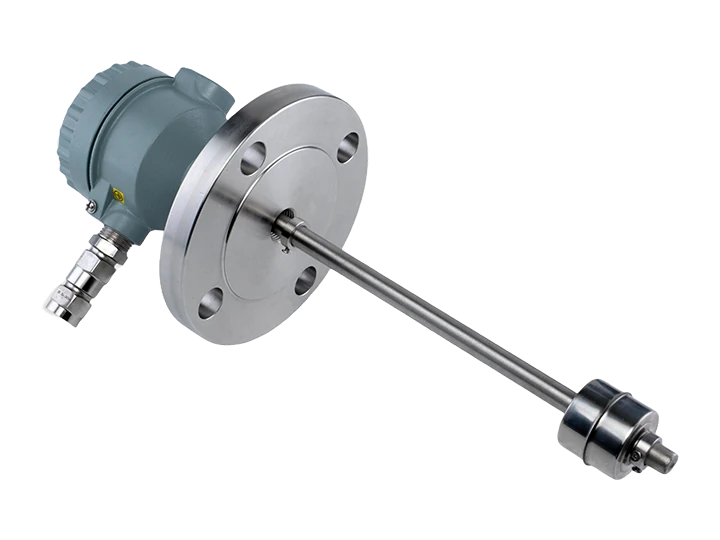
Description
It consists of a float and guide tube assembly in non-magnetic material to achieve undisturbed flux. A chain of closely spaced glass encapsulated reed switches and resistors are placed inside the guide tube. During rise and fall of liquid level, the float moves and actuates a reed switch in the chain, through a magnet system within it and develops a proportional voltage. The sensed voltage is fed to the transmitter located in the enclosure for conversion to a signal of 4-20 mA for use with PLC / DCS. The guide mechanism ensures stable and consistent readings even in turbulent or agitated liquids. Float and Guide type level transmitters provides an efficient, reliable and versatile solutions for continuous level measurements in a wide range of industrial applications providing real-time data that is crucial for process control and optimization.
Your benefits
The design of the float and guide system ensures minimal maintenance, as there are fewer moving parts compared to other level measurement technologies and they are less susceptible to wear and tear. This type of level transmitter can be customized for different tank sizes, liquid types and process conditions ensuring reliable performance across various industries such as Chemical and Petrochemical, Oil & Gas, Water Treatment, Food & Beverage and many more.
Technology
In a float and guide type level transmitter, a float is suspended on the surface of the liquid and as the liquid level rises or falls, the float moves accordingly. The float is designed in such a way that it is buoyant in the liquid ensuring it remains afloat and accurately follows the liquid level. The float is connected to a guide, often a rigid rod or tube, that ensures it moves in a controlled vertical motion preventing any lateral movement or instability. This guide helps the float maintain proper alignment along the measurement axis. The float’s position is then detected by a resistive reed chain and feed to transmitter that converts the float's position into an electrical 4-20 mA signal. This signal is then transmitted to a control system or display providing a continuous reading of the liquid level within the vessel.